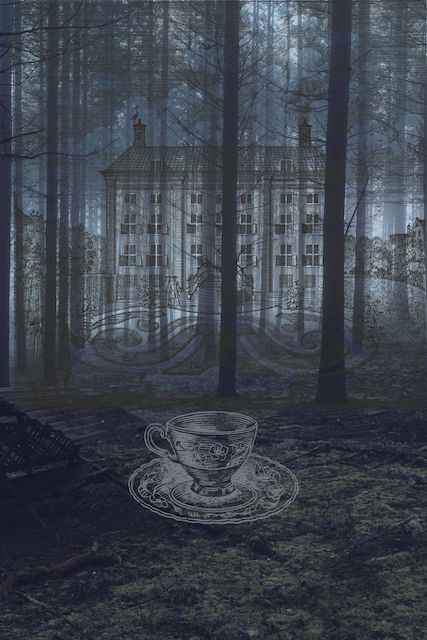
Donyae Coles’s Midnight Rooms is a slippery and disorienting haunted house story that is spun like a matrimonial fable in which the crumbling manor and the family that inhabits it are inextricable sources of the haunting. Readers are never quite sure of where they are in the narrative or whether they can really trust the third person narration from Orabella’s hazy perspective or their own perceptions.
At the start, 26-year-old Orabella Mumthrope overhears her paternal uncle Worrell speaking to an unidentified suitor in the parlor of her uncle and aunt’s Bristol home. Curious to meet the scruffy stranger Worrell intends to set her up with to discharge his duty to her late father, Orabella enters the room and agrees to speak to him privately in the garden. Up close, Elias Blakersby is gentle and disarming. He claims to have been impressed by Orabella’s beauty and demeanor at a party she’d attended with her cousin two years ago and unsuccessfully sought an introduction. Now at 31, he’s in need of a wife and in a position to secure Worrell’s cooperation by canceling his gambling debts. Despite the fact that she doesn’t know him and he essentially bought her from her uncle, Elias assures her that he’ll treat her much better than her cold relatives and give her whatever she desires. Orabella knows that her status as an orphaned woman with a modest dowry and mixed parentage greatly limits her prospects; if she doesn’t accept Elias, her uncle will only too gladly off-load her onto someone else. And she wants to believe that Elias’s warmth and promises of affection are sincere.
Orabella agrees to marry him. Then he blindsides her by insisting that they marry the next morning and immediately afterward travel to his family’s remote country estate, Korringhill Manor. Her uncle and aunt echo her surprise at his haste but nonetheless comply with his wishes. Tightly gripping Orabella’s hand before the rushed wedding, her aunt subtly reminds her of her duty to comply as well. Packing the book of fairy tales her father gifted her before his death and little else, Orabella leaves behind her only friend Jane and former city life to set off for Korringhill Manor with her new husband.
When they arrive, nothing is as Orabella expected: instead of the well-kept grandeur she envisioned on their three-day journey, Korringhill is dark, foreboding, and in disrepair. Orabella’s elderly father-in-law Hastings and the housekeeper Mrs. Locke each regard her with grim disdain, while her sister-in-law Claresta is inexplicably catatonic and the servants all fearfully retreat. The hallways of Korringhill are labyrinthine and endless, with so many rooms that are unused and off-limits. Orabella’s every movement is closely monitored and micromanaged, down to a strict schedule of enforced naps and compulsory cups of soporific, cloying, and honey-infused tea and wine. Elias urges her to keep her bedroom door locked at night “for her safety” and chooses to sleep in another room because he suffers from night terrors. Orabella finds all of this odd and disconcerting, yet she doesn’t want to make a fuss by raising her concerns, wanting above all to please Elias and be accepted by her new family. And with each sweet word, gift, and amorous touch, Elias silences her mounting doubts.
Yet her sense of disquiet never goes away and the strange noises and visions that seem to intensify at night only fuel her nightmares. As the days begin to blur into one another and events at the house grow increasingly more outlandish and horrific, Orabella fears she may lose more than just her grasp of time the longer she remains within Korringhill’s walls.
The difficult to pin down timeline and halting prose—with thoughts, dialogue, and exposition that tend to run into one another—add to the sense of unease and muddled, dreamlike quality of the narrative. Orabella frequently references fairy tales and seems to process her surroundings and circumstances through that lens. The overall effect of the style, pacing, concept, and setting amounts to something close to a fun house mirror version of Beauty and the Beast. Is Midnight Rooms an allegory for a particular type of toxic romantic relationship or a critique of patriarchal structures and the notion of marriage as a fixed happy ending? For Orabella, neither biological family nor the marriage of convenience her uncle orchestrates, one that later grows into a convoluted morass of fear and affection, are safe routes.
She is a protagonist characterized in a damsel in distress vein and seems simultaneously incapacitated by self-doubt, conditioning from years of hostility and emotional neglect in her uncle and aunt’s home, social dictates that she be submissive and dutiful as a wife, and the deluge of clearly drug-laden teas and wines her in-laws and their staff force upon her. Orabella’s character arc over the course of the novel goes from burden to prize/treasured bride to plaything/prey/vessel and ends with her as a traumatized expectant mother trying to rebuild her life.
The story’s atmosphere of dread and focus on an outsider who is lured into the dark, formerly grand estate and insular life of a wealthy, secretive English family obsessed with its own bloodline make it comparable to Silvia Moreno-Garcia’s Mexican Gothic, Guillermo del Toro’s 2015 film Crimson Peak, and the 2022 vampire film The Invitation. However, in those stories the heroines are allowed to be less passive, whether by being given motivation to actively stage attempts to flee their predicaments and/or allies to intercede. Orabella senses something is deeply wrong multiple times but is never really allowed to sit with those feelings and trust her instincts. Too often at crucial moments she’s made to freeze or appease and not respond to threats in other modes of self-preservation. The few actual or potential allies Orabella has are too geographically removed from her to be of immediate service, and those close by are quickly forgotten about, ignored, or otherwise neutralized.
When Orabella finally escapes Korringhill Manor and its many horrors, it’s not an act of her own that sets off her in-laws-turned-captors’ downfall but one of theirs. A stronger, more decisive ending could have involved Orabella seizing an opportunity amid the outburst of one of the Blakersby clan to fight back. The historical time period aside, her survival is left too much up to chance and their whims. The novel concludes with so many questions left unanswered. In the epilogue, despite everything that befell her at Korringhill and her husband’s role in her distress, Orabella’s predominant emotions towards Elias are still love, desire, and the inclination to trust his intentions in spite of her own instincts. There’s ambiguity as to what exactly follows. Paired with Orabella’s feelings, it’s an ending that seems purposeful but doesn’t quite land within the scope of the storytelling laid out. Midnight Rooms is an immersive, haunting, and wild ride of a story that confounds and gets under your skin.
LOGLINE: In Victorian England, Orabella Mumthrope, a biracial orphan with limited prospects, marries the son of an old and wealthy family. When her new husband whisks her away to his family’s manor in a remote part of the countryside, Orabella is thrown by the thick air of decay and secrecy that pervades it and quickly finds adjusting to married life to be a struggle for both her sanity and survival.
MOOD: A dark subversion of the fairy tale happily-ever-after that wrong-foots the reader at every turn alongside its imperiled heroine. With parallels to Crimson Peak, The Invitation, and Mexican Gothic, Midnight Rooms is full of spellbinding prose that unfolds like a peculiar and disturbing fever dream.
TITLE: Midnight Rooms
AUTHOR: Donyae Coles
GENRE: Horror, Gothic Horror, Thriller, Historical Fiction
PUBLISHER: Amistad, an imprint of HarperCollins
PUB DATE: 2 July 2024
LENGTH: 336 pages



 Connections